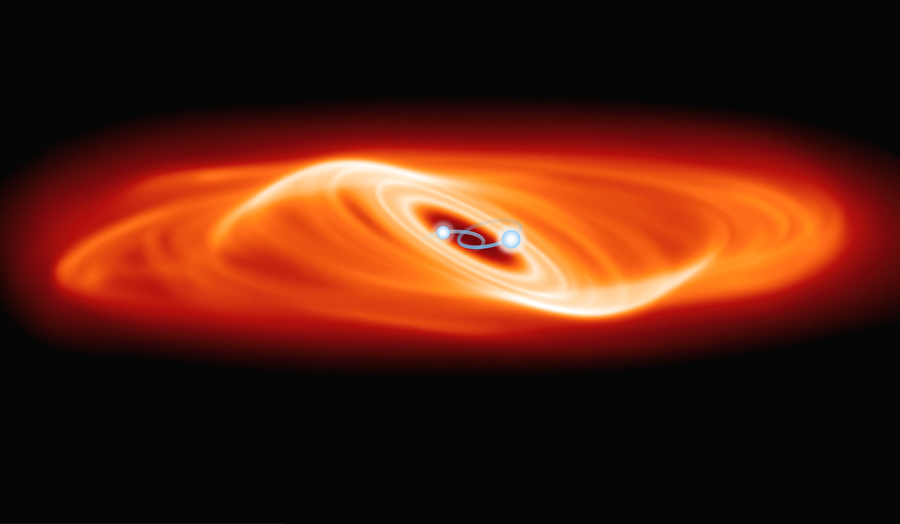
An illustration provided by the research team shows a binary star system.
BEIJING, July 17 (Xinhua) -- An international team led by a Chinese astronomer has announced that it has identified two new examples of rare binary star systems comprising two central stars orbiting each other in the universe.
The two systems, designated Bernhard-1 and Bernhard-2, are each surrounded by an unusual disk of gas and dust that lies at an angle to the orbits of the central stars, according to Zhu Wei with the Tsinghua University who leads the international team. The findings were published in the Astrophysical Journal Letters.
The surrounding dense gas, or protoplanetary disk, usually lies in the same orbital plane as the stars, just as most of the planets and moons in the solar system have the same orbital plane.
However, the newly discovered binary star systems are of a rare type, in which a circumstellar disk lies at an angle to the plane of the orbiting stars, said Zhu, adding that the disk wobbles like a spinning top because of the tilt.
Zhu explained that when a disk wobbles, it moves between Earth and the binary stars over a period of several decades, causing the brightness of the binary stars to vary regularly.
As seen from Earth, the systems dim as one of their binary stars moves behind the protoplanetary disk. When it can be observed again on Earth, the system's brightness returns to normal. The dimming of Bernhard-1 lasts for 112 days every 192 days, and that of Bernhard-2 for 20 days every 62 days, according to the findings.
The two binary star systems are located 3,000-10,000 light-years from Earth, and the discovery of the systems is of great importance to understanding planet formation, according to Zhu.
The study was undertaken in collaboration with professional and amateur astronomers as well as researchers from China and abroad.
Durning the 2026 Shanghai Cooperation Organization Media and Think Tank Summit, Xinhua Institute, a think tank affiliated with Xinhua News Agency, released "Upholding Fairness and Justice and Improvi
 English
 注册
注册


 首页
首页
 动态信息
动态信息
 交流活动
交流活动
 研究成果
研究成果
 成员信息
成员信息
 联系我们
联系我们